 DriveCircle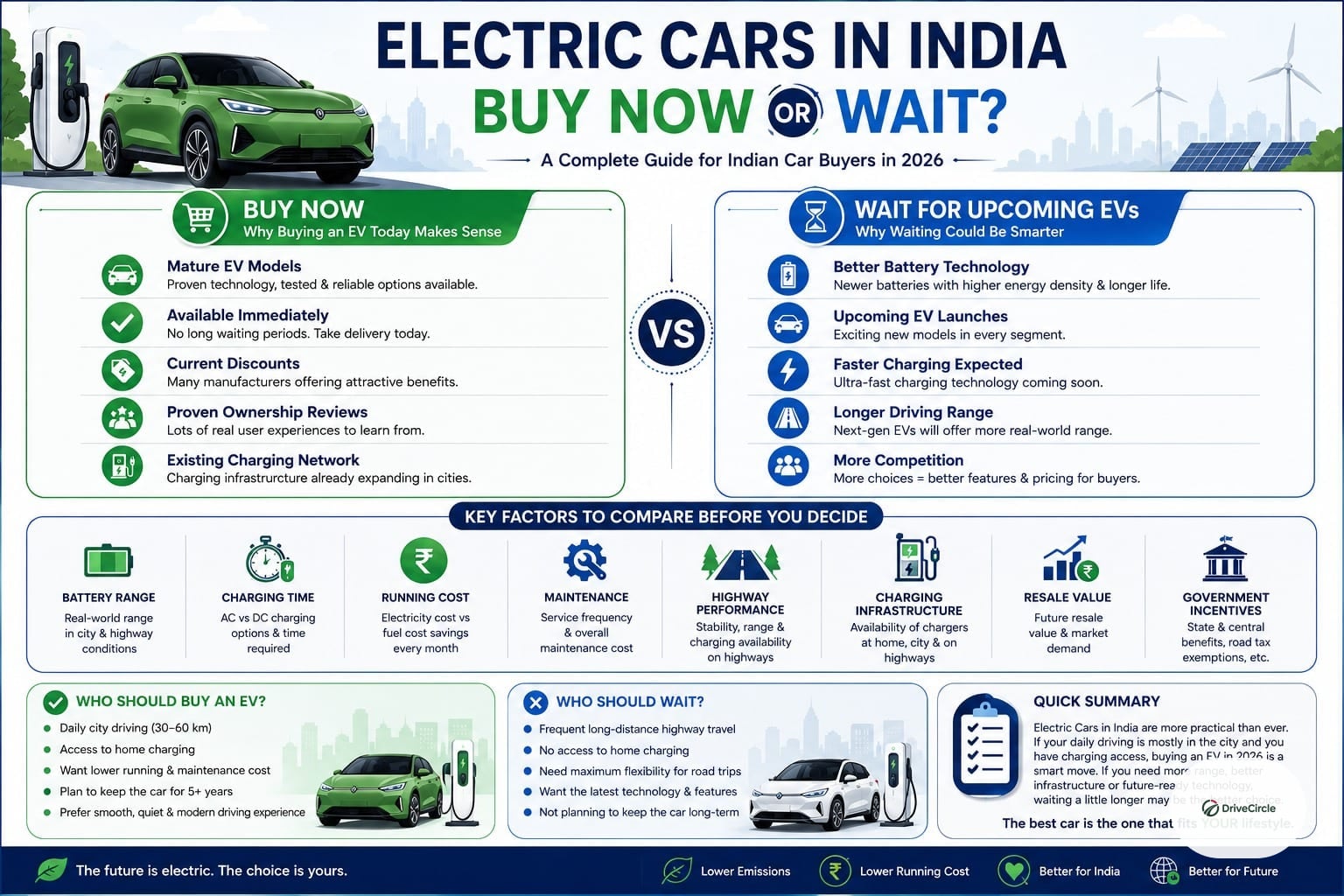
Electric cars in India are no longer experimental products bought only by early adopters. Buyers now have more models, longer claimed ranges and a growing charging network. Yet choosing an EV is still not as simple as comparing its certified range with the mileage of a petrol car.
The practical answer in 2026 is this: buy an EV now if you have dependable home or workplace charging and its real-world range comfortably covers your normal driving. Consider waiting—or buying a petrol or strong-hybrid alternative—if you cannot secure routine charging, frequently make unpredictable long-distance trips, or need resale value and outstation service support to be highly predictable.
The powertrain should fit the owner's life. It should not require the owner's life to be reorganised around the car.
The Quick Decision
| Your situation | What it suggests |
|---|---|
| Dedicated home or workplace charging, predictable daily use and occasional planned highway trips | An EV can be a strong choice now. |
| Apartment parking but no approved electrical route, meter or charging arrangement | Solve charging first; do not buy on an assumption. |
| Frequent travel on repeat highways with verified, compatible backup chargers | An EV may work, but test the route before purchase. |
| Frequent unplanned long-distance travel through areas with uncertain charging | Petrol, diesel or hybrid may remain more convenient. |
| Low annual usage and a large EV price premium | Calculate total cost carefully; lower running cost may not recover the premium. |
| Waiting only because future EVs may be better | Wait only for a specific model or capability—not for an undefined perfect EV. |
Start With Charging, Not Claimed Range
The most important EV-buying question is not, "How far can it travel?" It is, "Where will it normally charge?"
A home or workplace charger changes the ownership experience. The car can recover its daily usage while parked, so the driver rarely needs to make a separate charging stop. Without dependable private charging, the owner may have to plan around public-charger locations, availability, tariffs and waiting time.
Apartment residents should confirm the complete installation path before booking:
- Is the parking space fixed and close enough to an approved cable route?
- Will the resident welfare association or building manager permit the installation?
- Does the sanctioned electrical load support the proposed charger?
- Will electricity be billed through the flat's meter, a separate connection or a managed community charger?
- Who pays for cabling, protective equipment, earthing, load enhancement and future maintenance?
- Can the installation be used safely without loose extension cables or obstructing common areas?
The Ministry of Power's Guidelines for Installation and Operation of Electric Vehicle Charging Infrastructure, issued 17 September 2024 and subsequently amended, cover private parking, group housing societies, workplaces and public charging. They provide a national framework, but the actual connection process, tariff and approvals still depend on the relevant DISCOM, state regulator and building.
DriveCircle's home and apartment EV-charging guide explains the load, cabling, billing and safety checks in more detail.
Certified Range Is a Comparison Number, Not a Trip Guarantee
A certified range is useful for comparing vehicles tested under the same procedure. It is not a promise that every owner will reproduce that distance.
Actual range changes with:
- speed and acceleration;
- city traffic versus sustained highway driving;
- air-conditioning and cabin heating;
- temperature, rain, wind and elevation;
- passenger and luggage load;
- tyre pressure and wheel size;
- battery temperature and state of charge; and
- the reserve the driver keeps before the next charger.
Do not apply one universal "real-world percentage" to every EV. Instead, look for repeated owner reports for the exact battery, variant, wheel size and route type. Give more weight to trips that disclose speed, weather, air-conditioning use, starting charge, ending charge and distance.
A useful pre-purchase exercise is to take the longest journey you make regularly and map it using conservative range—not the best number in the brochure. Confirm a compatible primary charger and a backup that can be reached with a sensible reserve.
India Has More Chargers, but a Map Pin Is Not a Charging Plan
India's public charging network is expanding, supported by government programmes and private charge-point operators. The Bureau of Energy Efficiency is the central nodal agency for public charging infrastructure and operates the EV Yatra discovery platform. PM E-DRIVE also provides ₹2,000 crore of support for public charging infrastructure under its published scheme allocation.
However, a national station count does not tell a car owner whether a particular connector is working, accessible and free at the required time. Before depending on a location, verify:
- connector compatibility;
- AC or DC charging;
- rated power and the car's own acceptance limit;
- live operating status;
- access hours and parking restrictions;
- current tariff and payment method;
- recent owner check-ins; and
- a backup location on the same route.
Read why India's public-charger total does not equal the number of dependable fast car chargers before planning an EV road trip.
Calculate Ownership Cost Using Your Own Driving
"EVs are cheaper to run" can be true while "this EV will save me money" is false. The result depends on purchase price, financing, usage and where the vehicle charges.
Use these basic calculations:
EV energy cost per kilometre = electricity billed for charging ÷ kilometres driven from that energy
Fuel cost per kilometre = local fuel price ÷ the comparison car's real-world kilometres per litre
Simple recovery period = additional on-road EV cost ÷ expected monthly operating-cost saving
The simple recovery period is only a starting point. A fair comparison should also include:
- loan interest on the price difference;
- home-charger and installation cost;
- charging losses and fixed electricity charges;
- public fast-charging tariffs used on trips;
- insurance quotations for both cars;
- scheduled service and consumables;
- tyre-replacement cost;
- state road-tax, registration and incentive position; and
- expected ownership period and resale value.
Do not use an outdated subsidy in the calculation. The central PM E-DRIVE scheme's published eligible categories do not include privately purchased electric passenger cars. State-level road-tax exemptions, registration benefits and purchase or scrappage incentives vary, can have price caps and quotas, and may change before delivery.
Low running cost produces the greatest financial benefit for an owner who drives enough and charges mostly at home. A low-mileage buyer paying a substantial upfront premium may enjoy the EV but never recover that premium through energy and maintenance savings alone.
Battery Degradation: Ask Better Questions
Every traction battery loses some usable capacity with age and use. That fact does not support a universal claim about how much range every EV will lose after two, five or eight years. Battery chemistry, temperature control, charging behaviour, software buffers and usage differ between models.
The battery warranty is more useful than a generic internet estimate—but only after reading its terms. Ask the dealer to provide the actual warranty document and confirm:
- time and kilometre limit;
- the usable-capacity threshold that qualifies for a claim, if specified;
- whether the warranty covers the complete pack or individual components;
- diagnostic, labour and transport conditions;
- exclusions concerning damage, water ingress, accidents or unauthorised work;
- requirements concerning scheduled inspections or software updates; and
- whether the warranty transfers to the next owner.
A warranty protects against defined failures; it is not a guarantee that range will remain unchanged. Buyers planning long ownership should also ask the manufacturer how battery-health reports, module repair and out-of-warranty support are handled.
Maintenance Is Simpler, but an EV Is Not Maintenance-Free
An EV does not need engine oil, spark plugs or an exhaust system. Regenerative braking can reduce friction-brake use. These advantages can lower routine powertrain maintenance.
But EV owners must still maintain tyres, alignment, brakes, suspension, air-conditioning, coolant where specified, the 12-volt battery, wipers, filters and charging equipment. Heavy vehicles and instant torque can make tyre wear sensitive to driving style and alignment. Software and connected features can also affect the ownership experience even when the electric drivetrain is healthy.
Before choosing a model, check whether the nearest authorised workshop can diagnose its high-voltage system, whether roadside assistance covers your normal routes, and how the manufacturer handles a vehicle that cannot be driven to the service centre.
Insurance, Repairs and Resale Deserve Their Own Checks
Do not assume that lower servicing automatically means lower total repair risk. Obtain real insurance quotations before booking and compare:
- insured declared value;
- own-damage premium and deductibles;
- battery, charger and charging-cable coverage;
- water-ingress and consequential-loss wording;
- roadside assistance and towing limits; and
- cashless repair availability near your location.
EV resale values are still developing across brands and cities. Future value will depend on battery health, warranty remaining, model support, software condition, new-car price changes and buyer confidence. If you normally replace a car after two or three years, obtain written buyback or guaranteed-resale terms where available and read the deductions carefully. Do not treat a sales estimate as guaranteed market value.
Safety Must Be Compared Model by Model
"EV" is a powertrain type, not a safety rating. Compare crash structure, airbags, electronic stability control, child-restraint compatibility, active-safety equipment and official test results for the exact model.
Bharat NCAP publishes vehicle-level safety ratings, including results for electric models. A five-star result for one EV does not apply to every electric car, just as a result for one petrol model does not apply to every petrol car.
Owners in flood-prone areas should also read the manufacturer's guidance on charging and operating around water. Do not charge from a damaged, submerged or visibly wet installation, and do not attempt high-voltage repairs outside an authorised, properly equipped facility.
When Buying an EV Now Makes Sense
An EV is a strong 2026 choice when most of these statements are true:
- You have confirmed home or workplace charging.
- Your normal daily driving uses only a comfortable portion of realistic range.
- Your frequent highway routes have verified compatible chargers and backups.
- You expect to keep the car long enough to benefit from lower operating costs.
- The model has adequate local service and roadside-assistance coverage.
- You have checked battery-warranty terms rather than relying on a salesperson's summary.
- The EV works financially even without assuming an unconfirmed future subsidy or resale value.
- You prefer its quietness, smooth response and driving character even if the spreadsheet saving is modest.
When Waiting Is Reasonable
Waiting is sensible when it solves a specific problem:
- Your building has not approved a safe charging installation.
- No current model provides enough conservative range for a repeat journey.
- Your regular route lacks dependable compatible chargers and alternatives.
- The nearest trained service facility is impractically far away.
- You need a body style, seating layout or safety feature that announced models may provide.
- The current price premium does not work for your annual usage.
- You change cars frequently and cannot accept resale uncertainty.
"Future batteries will be better" is not, by itself, a useful reason to postpone indefinitely. Cars, phones and computers will always improve. Wait for a named vehicle, confirmed specification, launch window or infrastructure change that directly fixes your constraint. Treat leaks, unofficial dealer promises and expected prices as unconfirmed until the manufacturer publishes them.
EV, Hybrid or Petrol: Which Use Case Fits?
| Priority | EV | Strong hybrid | Petrol |
|---|---|---|---|
| Predictable city use with home charging | Often the strongest fit | Efficient alternative | Simple but higher fuel use |
| Frequent unplanned highway travel | Route-dependent | Highly flexible | Highly flexible |
| No private charging | Depends heavily on local public charging | No charging dependency | No charging dependency |
| Lowest energy cost at high usage | Usually strongest with home charging | Moderate | Usually weakest |
| Short refuelling stop | Weakest | Strong | Strong |
| Powertrain routine maintenance | Generally simpler | Combines engine and hybrid systems | Conventional and widely supported |
This is a use-case comparison, not a ranking of every car. Price, safety, reliability, comfort and service quality still have to be compared model by model.
The Eight-Question Test Before Booking
- Where will the car charge on at least 80% of normal days?
- What range do owners of the exact variant report in conditions similar to yours?
- Can your longest repeat trip be completed with a verified primary and backup charger?
- What is the EV's on-road premium over a genuinely comparable alternative?
- How many kilometres will you realistically drive each year?
- What exactly does the battery warranty cover, and is it transferable?
- Where is the nearest high-voltage-capable service centre and what roadside support is included?
- Would you still choose this car if fuel savings and resale value were more conservative than expected?
If the first three answers are unclear, do not book yet. Resolve charging and route feasibility first. If those answers are strong, an EV can already be an excellent everyday car in India; waiting another year may add choices, but it may not materially improve your own use case.
Frequently Asked Questions
Are electric cars worth buying in India in 2026?
They can be—especially for drivers with home or workplace charging, predictable use and sufficient real-world range. They are not automatically the best option for every buyer.
Should I wait for better battery technology?
Wait when a confirmed upcoming model or technology solves a specific limitation. Do not wait indefinitely for a vague promise of better batteries; future vehicles will always improve.
Can I own an EV without home charging?
Yes, but convenience and cost depend on dependable nearby public or workplace charging. Test that routine before buying instead of assuming map listings will always be available.
Will an EV battery need replacement after a few years?
There is no universal replacement age. Capacity normally changes with age and use, while defects and degradation claims are governed by the model's specific warranty. Read its thresholds and exclusions.
Are private electric cars covered by PM E-DRIVE purchase incentives?
The scheme's published eligible categories do not include privately purchased electric passenger cars. A buyer should separately verify current state road-tax, registration and other benefits.
Is an EV suitable for highway trips?
It can be, if the vehicle has adequate realistic range and the route has working, compatible charging with backups. Frequent unplanned travel through poorly served areas remains easier with petrol, diesel or hybrid vehicles.
Final Verdict
Electric cars in India have reached the point where many buyers can purchase one now without treating themselves as an experiment. But the right buyer is defined less by budget than by charging access, driving pattern and tolerance for trip planning.
Buy now when the current vehicle already meets your range, charging, service and cost requirements. Wait when a defined shortfall—such as apartment charging, highway coverage, required seating or local service—has no workable solution today.
The best decision is not "electric versus petrol" in isolation. It is the car and ownership system that create the fewest compromises for the way you actually drive.
For EV Owners: Help Improve the Evidence
Owner experience can reveal practical details that specifications miss. If you already use an EV in India, share:
- Your model, city and typical city/highway range, with air-conditioning use.
- Whether you charge at home, work or publicly—and the biggest charging problem you have faced.
- One ownership detail you wish you had known before purchase.
- Whether you would buy the same EV again, and why.
Community responses are owner reports, not statistically representative evidence. DriveCircle may use recurring themes for future reporting after removing personal information and checking factual claims independently.
Last fact-checked: 6 August 2026. Incentives, electricity tariffs, charging networks, vehicle specifications and warranties can change. Verify the exact model, state policy, DISCOM process and written warranty before purchase.
Sources and references
- Guidelines for Installation and Operation of Electric Vehicle Charging Infrastructure — Ministry of Power
- E-Mobility and EV Yatra public-charging information — Bureau of Energy Efficiency
- PM E-DRIVE scheme portal and eligible categories — Ministry of Heavy Industries
- PM E-DRIVE EV public-charging operational guidelines, 26 September 2025 — Ministry of Heavy Industries
- Vehicle safety ratings — Bharat NCAP