 DriveCircle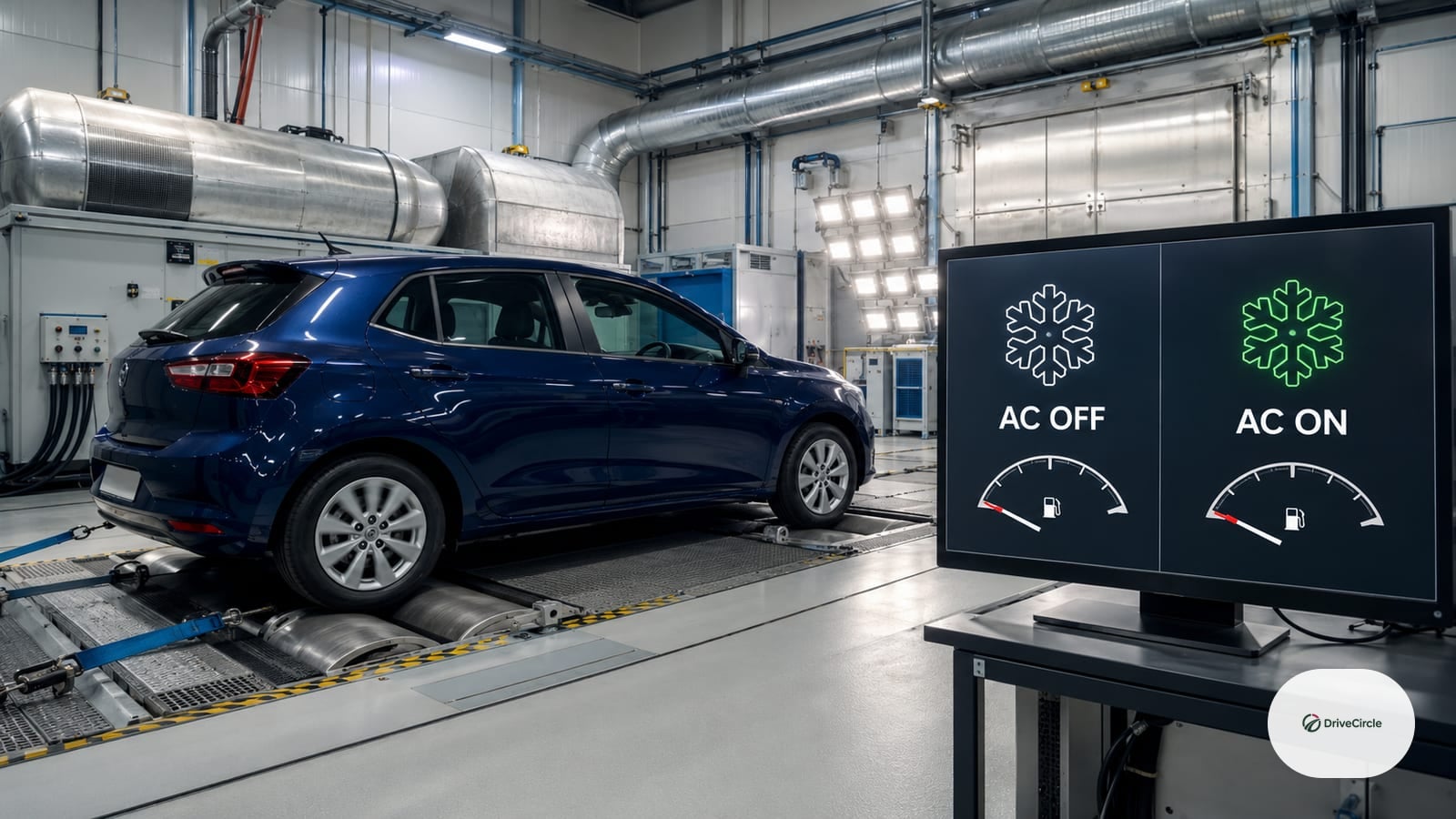
Indian car buyers are used to one official mileage or range number and a very different result in traffic. Air-conditioning is only one reason for that gap, but it is an important one in a country where the AC may run during most journeys.
The Ministry of Road Transport and Highways published a draft in January 2026 proposing that M1-category vehicles manufactured or imported in India be tested for fuel consumption with the air-conditioning system operating under AIS-213. The draft proposed 1 October 2026.
A subsequent report on 1 June 2026 said the notified implementation for new vehicle models had moved to April 2027 after consultation with the automobile industry, with existing models expected to receive a few additional months beyond that — though the exact extended timeline for existing models has not yet been announced. Reporting also confirms the AC-on/AC-off testing norms are intended to apply to both internal-combustion and electric vehicles.
The change should give buyers an additional standardised comparison point. It will not turn a laboratory figure into a promise of exactly what every owner will achieve on Bengaluru traffic, a Rajasthan highway or a Himalayan climb.
What the Official January Draft Proposed
The MoRTH draft notification, G.S.R. 26(E), dated 13 January and published on 14 January 2026, proposed adding a sub-rule requiring all M1 vehicles manufactured or imported in India from 1 October 2026 to be tested for fuel consumption with the AC operating according to AIS-213.
M1 generally covers passenger vehicles designed to carry up to eight passengers in addition to the driver — ordinary hatchbacks, sedans, SUVs and MPVs fall within this broad category when they meet the classification.
The document was explicitly a draft and invited objections or suggestions for 30 days. It should therefore not be cited as proof that its original October date became the final implementation date.
Why April 2027 Is Now Being Reported
Reporting from June 2026 says the revised timeline for new models was notified for April 2027 after industry consultation, with existing models expected to get a few additional months on a timeline still to be announced. This is why many search results conflict: January coverage repeated the draft's 1 October 2026 proposal, while later coverage describes a revised April 2027 start for new models.
A separately published final Gazette notification specifically confirming the April 2027 date was not locatable at the time of writing — only the January draft (proposing October 2026) is directly linkable above. Until a final Gazette is published and linked, phrase the date carefully: reported April 2027 implementation for new models, not an unsupported claim that every car already on sale changes on the same day.
What Is AIS-213?
ARAI's 2024–25 annual report describes AIS-213 as the procedure for measuring emissions and fuel consumption with the air-conditioning system in operation for M1-category vehicles. ARAI's climatic test facility lists AC-on testing capability under AIS-213, along with a climatic chamber, solar simulation and chassis-dynamometer equipment.
See ARAI's 2024–25 annual report and ARAI's emission-test-facility description.
The important consumer point is standardisation. The result is produced under controlled conditions so different vehicles can be compared more fairly than two owners reporting mileage from different cities, temperatures, speeds and driving styles.
What Buyers May See
Reporting says manufacturers and importers will disclose efficiency with the AC on and off in owner manuals and on their websites. The final notification should be checked for the exact format, implementation date and vehicle coverage before publication.
If dual figures are presented, a buyer should read them as two laboratory reference points:
- AC off: the vehicle measured under the applicable test procedure without the AC load being included in the new comparison.
- AC on: the vehicle measured under AIS-213 conditions with the air-conditioning system operating.
Neither figure should be labelled “real-world mileage.” Both remain controlled test results.
Why AC Changes Efficiency
In a petrol, diesel or many hybrid vehicles, the air-conditioning system adds load that ultimately requires energy from the fuel. In an EV, cabin cooling draws energy from the battery. The effect is not a fixed percentage across every car.
It can vary with:
- Outside temperature and solar load.
- Cabin size, glazing and insulation.
- Compressor type and control strategy.
- Selected cabin temperature and fan speed.
- Starting cabin temperature.
- Engine, motor and hybrid-system efficiency.
- Journey duration and average speed.
- Occupancy and door-opening frequency.
Do not publish a universal claim such as “AC reduces mileage by 10%” unless a source and test conditions are stated. The rule exists partly because the impact needs to be measured consistently rather than guessed.
AC-On Mileage Still Will Not Equal Your Mileage
Even a better laboratory comparison cannot reproduce every Indian journey. Real efficiency is also affected by:
- Stop-start traffic and long idling.
- Short trips with repeated cold starts.
- Speed and acceleration.
- Tyre pressure and alignment.
- Passenger and luggage load.
- Road gradient and surface.
- Rain, wind and ambient temperature.
- Regeneration opportunities in hybrids and EVs.
- Battery conditioning and charging losses.
- Fuel quality and vehicle maintenance.
An AC-on number can reduce one blind spot. It cannot remove all the variables between a laboratory and the road.
How to Compare Two Cars Properly
When dual figures become available, compare like with like:
- Use figures produced under the same test standard.
- Match the exact engine, transmission, battery and drivetrain variant.
- Compare AC-on with AC-on — not one car's AC-on figure with another car's AC-off claim.
- Check whether the number is fuel consumption, km/l, energy consumption or range.
- Note the publication and applicability date.
- Treat owner reports as context, not a substitute for controlled comparison.
- Test-drive the vehicle in conditions reasonably similar to your use.
Turn the Figures Into an Annual-Cost Estimate
For a petrol, diesel or CNG vehicle:
Annual fuel required = annual kilometres ÷ official efficiency in km/l or km/kg
Estimated annual fuel cost = annual fuel required × your local fuel price
Calculate it separately using the AC-on and AC-off figures. The difference gives a controlled estimate of the AC-related range of annual consumption — not a guaranteed bill.
For an EV:
Estimated driving energy = annual kilometres ÷ efficiency in km/kWh
Then account separately for charging losses and your actual home or public-charging tariff. Do not confuse battery-to-wheel consumption with energy drawn from the electricity meter unless the published figure explicitly includes charging losses.
What This Means for Existing Owners
The policy is primarily about testing, certification and disclosure by manufacturers. It is not a requirement for an owner to take an existing private car for a new AC mileage test.
An existing owner can still run a useful personal comparison:
- Use the same fuel pump and tank-to-tank method where practical.
- Compare several full-tank cycles rather than one short trip.
- Keep tyre pressure, route, load and driving style broadly similar.
- Record outside temperature and AC use.
- Do not switch off the AC if it causes discomfort, fatigue or windscreen fogging merely to chase a number.
Safety and clear visibility matter more than a marginal efficiency gain.
What Remains to Be Confirmed
The following points should still be verified against the final Gazette once it is published:
- The exact April 2027 commencement wording.
- Whether the date is limited to newly type-approved models.
- The extension granted to existing certified models.
- How EV energy consumption and range disclosure are expressed.
- Where manufacturers must display AC-on and AC-off figures.
- Whether any transitional or exemption provisions apply.
The Practical Takeaway
AC-on testing is useful because it introduces a controlled measurement for a load Indian drivers use every day. It should make official comparisons more informative, especially when buyers calculate running cost across petrol, diesel, CNG, hybrid and electric options.
But the correct message is not “brochure mileage will now become real mileage.” The correct message is: buyers may receive a second, more relevant laboratory figure — and should still interpret it alongside traffic, weather, load, route and ownership data.
Related DriveCircle reads: real-world mileage versus brochure mileage, EV, hybrid, CNG or petrol, EV range reality and E20 and E85 petrol explained.
This article summarises policy documents and reporting available on 2 August 2026. Regulations and implementation timelines can change. Confirm the final Gazette and current manufacturer disclosures before relying on them for a purchase decision.