 DriveCircle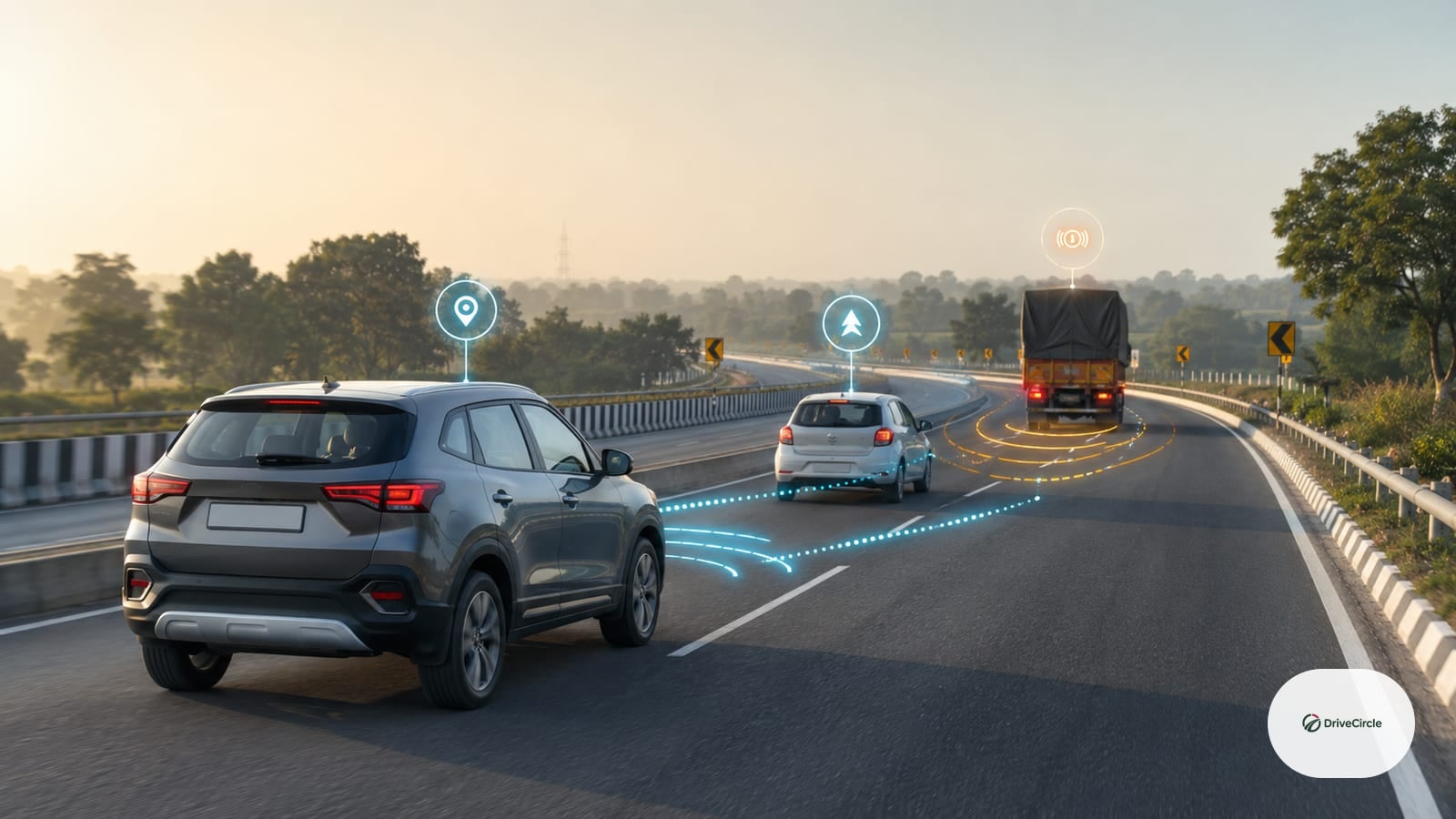
On 24 July 2026, the Ministry of Road Transport and Highways (MoRTH) issued a draft notification — G.S.R. 665(E) — proposing that Vehicle-to-Vehicle (V2V) communication become a required fitment on new vehicles from October 2028. This is a real, dated development, and it's worth understanding properly. But it's important to be precise about what has actually happened: the government has proposed a rule, not finalised one. Objections and suggestions were invited for 30 days after the draft was issued, and the final notified version — including its exact scope, cost impact and technical detail — is not yet settled.
This article separates what's confirmed, what's proposed, what remains genuinely unknown, and where a claim is DriveCircle's own analysis rather than an official position.
What Is Vehicle-to-Vehicle Communication?
In plain terms, V2V allows equipped vehicles that are near one another to exchange short safety messages about their own movement — things like location, speed, direction, acceleration or sudden braking. A receiving vehicle can use these messages to warn its driver about a developing situation that isn't yet visible to the driver or the car's own cameras and sensors.
It is not vehicles “talking” to each other in any conversational sense — it's a continuous, automated exchange of short status messages between nearby equipped vehicles.
A Practical Example on an Indian Highway
A car is travelling on an expressway in dense fog. Several vehicles ahead, a truck brakes suddenly. The following driver can't see the truck — fog and the vehicles in between block the view, and the car's own camera has no line of sight to the hazard. If both vehicles, and enough of the traffic in between, are V2V-equipped, a warning could reach the following car before its own sensors or its driver's eyes ever see the stopped truck ahead.
This is the central benefit V2V is designed around: a warning that travels beyond line of sight, not just what a car's own sensors can directly detect.
What Information Could Vehicles Exchange?
Based on the general design intent of V2V safety systems internationally, expected message types include:
- Speed
- Direction
- Position
- Acceleration
- Sudden braking
- Stationary or disabled status
- Collision-risk warnings
- Emergency-vehicle presence
These are reasonable expectations of the category, not a confirmed final feature list — the exact mandatory data set will be defined by AIS-230, and DriveCircle will update this article once that technical standard is public.
Situations Where V2V May Help
- Sudden braking several vehicles ahead
- A stationary vehicle just past a blind curve
- Dense fog or otherwise poor visibility
- Vehicles approaching an obscured junction
- Developing highway pile-up risk
- Blind-spot lane-change situations, if the other vehicle is equipped
- An approaching emergency vehicle
- A broken-down truck on an unlit road at night
- A two-wheeler obscured behind a larger vehicle, if the two-wheeler is also equipped
What V2V is not designed to do: warn about an unequipped animal on the road, a pedestrian, a pothole, or an older vehicle with no V2V hardware — unless some other sensor system or roadside infrastructure separately detects and broadcasts that hazard. V2V only knows about what other equipped vehicles (or equipped infrastructure) tell it.
V2V vs ADAS: Different Information Sources
| System | Primary information source | Main limitation |
|---|---|---|
| Camera/radar ADAS | The vehicle's own sensors | Generally limited by sensor range and direct visibility |
| V2V | Messages from nearby equipped vehicles | Depends on how many nearby vehicles are also equipped |
| V2I (vehicle-to-infrastructure) | Roadside infrastructure | Depends on how much road infrastructure actually participates |
| Connected-car telematics | Cloud/mobile network | May depend on network coverage and an active service subscription |
ADAS tries to see what's immediately around the car using its own sensors. V2V instead receives safety information transmitted by other vehicles, which can extend awareness beyond what any single car can directly see. The two are complementary, not competing — a well-equipped future car is likely to run both. Read DriveCircle's guide to ADAS and TPMS safety features for how camera/radar systems work today.
Importantly, V2V is not automatically autonomous driving. A V2V warning does not mean the vehicle will brake by itself — whether and how a warning translates into automatic braking, if at all, is a separate design decision for each manufacturer's system, not something inherent to V2V itself.
Does V2V Require Mobile Internet or 5G?
This isn't fully settled yet, and DriveCircle won't give an absolute answer until AIS-230 is public and verified. What can be said with reasonable confidence: safety-oriented V2V systems are generally designed around short-range, direct vehicle-to-vehicle communication rather than routing every safety alert through a conventional mobile-data connection, precisely because a safety warning needs to work reliably and with minimal delay, regardless of network coverage at that exact spot on the highway. India's exact communication technology, spectrum allocation and interoperability framework remain part of ongoing regulatory and technical work — the Telecom Regulatory Authority of India (TRAI) has run a separate consultation on V2X communication technology and spectrum, but that is a regulatory input process, not the final confirmed technical implementation.
Why the Number of Equipped Vehicles Matters
V2V has a network effect. One equipped vehicle can only exchange alerts with other equipped vehicles nearby — the benefit scales up as more cars, trucks, buses and two-wheelers on the road carry compatible systems. Older, unequipped vehicles will remain a large share of Indian traffic for many years after any 2028 fitment date, which means cameras, radar, attentive driving and good road infrastructure will all remain necessary regardless of how V2V adoption grows.
What Would the Driver Actually See?
Possible driver-facing interfaces for a V2V warning could include an instrument-cluster alert, a head-up-display warning, a sound alert, steering-wheel or seat vibration, a directional collision warning, or an emergency-vehicle alert. None of these should be treated as mandated until the final technical standard confirms the required interface — manufacturers may implement the driver-facing experience differently within whatever AIS-230 requires functionally. For two-wheelers specifically, any eventual interface needs to be designed carefully so an alert informs the rider without becoming a dangerous distraction.
Privacy and Cybersecurity Questions
This deserves serious attention, and much of it remains open pending the final standard:
- Whether V2V messages use temporary, rotating identifiers or persistent ones tied to a specific vehicle
- Protection against a vehicle's location being tracked over time via its V2V broadcasts
- Prevention of spoofed or falsified vehicle messages from a bad actor
- Authentication of messages between vehicles from different manufacturers
- How software updates to V2V systems are secured
- Protection against fake braking or crash alerts being injected into the system
- Data-retention limits on any V2V-related records
- Who can access diagnostic or incident data generated by the system
- Whether an owner can disable V2V, and what the consequence of doing so would be
- How system failures get reported and to whom
DriveCircle is not claiming V2V continuously exposes an owner's name or registration number to nearby vehicles — that would depend entirely on how AIS-230 defines the message identifiers, which isn't public yet. This section flags the right questions to ask once the standard is published, not a confirmed privacy risk.
Will New Cars Get More Expensive?
Almost certainly some cost impact exists — additional communication hardware, antennas, software and the certification/testing process all cost money to develop and homologate. Whether and how much of that gets passed on to buyers is a manufacturer decision DriveCircle can't predict. Some earlier reporting cited estimates in the ₹5,000–₹7,000 range; treat that specifically as an estimate from earlier reporting, not a notified consumer price — no official consumer price increase has been stated, and this article will not invent one.
Will Existing Cars Need Retrofitting?
Based on the current July 2026 draft's language, mandatory fitment applies to vehicles manufactured from 1 October 2028 — it does not currently establish a blanket retrofit requirement for older, already-registered vehicles. That said, a later final notification or a separate amendment could change this position, so don't treat this as a permanent guarantee that older cars are excluded forever — it's the current draft's position, and worth re-checking once the rule is finalised.
What Should Someone Buying a Car in 2026–2028 Do?
- Don't delay a car purchase you actually need just because of a draft 2028 proposal — it isn't finalised, and specific dates or requirements could still shift.
- If you're planning to keep a car for many years, it's reasonable to ask the manufacturer about its connected-safety hardware roadmap and software-update support.
- Don't assume an existing connected-car subscription means the vehicle is already AIS-230 V2V-ready — those are different systems built for different purposes.
- Confirm V2V readiness only through the manufacturer's official specifications, not a dealer's verbal assurance.
- Treat any unofficial dealer promise about future V2V compatibility cautiously until it's in writing.
- Check whether the eventual final rule is tied to a vehicle's manufacturing date, not its registration date — the draft language is specifically about manufacture date, which matters if you're buying a car built before but registered after the cutoff.
What Happens Next?
The regulatory path from here follows a fairly standard sequence: the draft notification (already issued), a public and industry comment period, government consideration of those comments, possible modification of the draft, a final Gazette notification, AIS-230 testing and homologation work by manufacturers, actual OEM implementation, and eventually vehicle-level consumer disclosures about what's fitted. Every date and requirement mentioned in this article reflects the July 2026 draft as it currently stands — the wording, timeline or scope can still change before final notification.
Frequently Asked Questions
What is V2V communication?
A system that lets nearby equipped vehicles automatically exchange short safety messages — like speed, position or sudden braking — so a receiving vehicle can warn its driver about a hazard it can't yet see itself.
How does V2V differ from ADAS?
ADAS uses a vehicle's own cameras and radar to see its immediate surroundings; V2V instead receives information broadcast by other equipped vehicles, extending awareness beyond direct line of sight. The two complement each other rather than replacing one another.
Is V2V mandatory in India?
Not yet. MoRTH's draft notification (G.S.R. 665(E), 24 July 2026) proposes mandatory AIS-230-compliant V2V fitment on new L, M and N category vehicles from 1 October 2028, with an earlier compliance requirement from 1 October 2027 for vehicles that choose to fit it before that. It remains a draft pending final notification.
Which vehicles are covered by the proposal?
Categories L (two- and three-wheelers), M (passenger vehicles, including cars and buses) and N (goods vehicles, including trucks), as manufactured from the relevant proposed date.
Will existing cars need retrofitting?
The current draft's mandatory-fitment language applies to vehicles manufactured from October 2028 onward — it does not currently set a universal retrofit deadline for older vehicles, though this could change in a future amendment.
Does V2V require internet or 5G?
Not confirmed either way yet. Safety-oriented V2V is typically designed around direct short-range communication rather than routing through a mobile network, but India's exact technical implementation is still under regulatory review, including a separate TRAI consultation on spectrum.
Can V2V automatically apply the brakes?
Not inherently — a V2V warning is information delivered to the driver (or to the vehicle's own systems). Whether it triggers automatic braking depends on a separate design decision by the manufacturer, not on V2V itself.
Will it increase new-car prices?
Likely some cost impact exists from added hardware and certification, but no official consumer price figure has been notified. Earlier reported estimates of ₹5,000–₹7,000 are unofficial and should be treated as such.
Can V2V track a car's location?
This depends on how AIS-230 defines the message identifiers — whether they're temporary/rotating or persistent — which isn't public yet. It's a legitimate open question, not a confirmed feature of the system.
What is AIS-230?
The Automotive Industry Standard expected to define the technical requirements for V2V systems in India, developed under ARAI's AIS framework. It is the standard referenced by the July 2026 draft notification.
Related DriveCircle reads: ADAS and TPMS safety features, connected cars and owner data, Bharat NCAP ratings explained, community road intelligence, and the new-car PDI checklist.
This article is based on MoRTH's draft notification G.S.R. 665(E) dated 24 July 2026 and related public reporting available as of early August 2026. This is a draft proposal, not a finalised rule — the timeline, technical scope, cost impact and retrofit position can all change before final notification. Verify the current official status before making a purchase decision based on it.
Sources and references
- Draft G.S.R. 665(E) — proposed AIS-230 V2V fitment timeline for L, M and N category vehicles — Ministry of Road Transport and Highways (accessed 2026-08-05)
- TRAI consultation on V2X communication technology and spectrum — Telecom Regulatory Authority of India (accessed 2026-08-05)
- AIS standards directory — Automotive Research Association of India (ARAI) (accessed 2026-08-05)